A Pragmatic Left-Shift Methodology: Tools & Techniques for Exploring and Building Domain-Specific SoCs
How to shift verification, exploration, and design entry left, catching bugs at spec time instead of silicon time.
The system-on-chip landscape is undergoing a fundamental shift. As AI, ML, and security workloads outpace general-purpose architectures, we increasingly need silicon that is tailor-made for a domain. At the same time, Dennard scaling is long gone and Moore’s Law is wobbling, so raw transistor abundance no longer rescues poor architectural choices. The economic trade-off is clear: hardware is fast yet expensive, software is cheap yet slow. The design challenge is to decide what to harden and what to leave in software.
Domain-Specific Architectures (DSAs), heterogeneous accelerators, tightly coupled data-flow engines, vector extensions, promise the necessary performance-per-watt. Yet they explode the design space: hundreds of tunable parameters across IP, memory, and networks create a search space that dwarfs traditional CPUs.
Problem Statement
Traditional RTL-first, back-loaded verification flows are too slow and error-prone for DSAs. Bugs that survive to silicon cost orders of magnitude more to fix than those caught at spec time. To ship competitive chips we must shift-left every activity, specification, modeling, design entry, verification, and exploration, while maintaining high confidence in correctness.
Specification Fidelity & Early Modeling
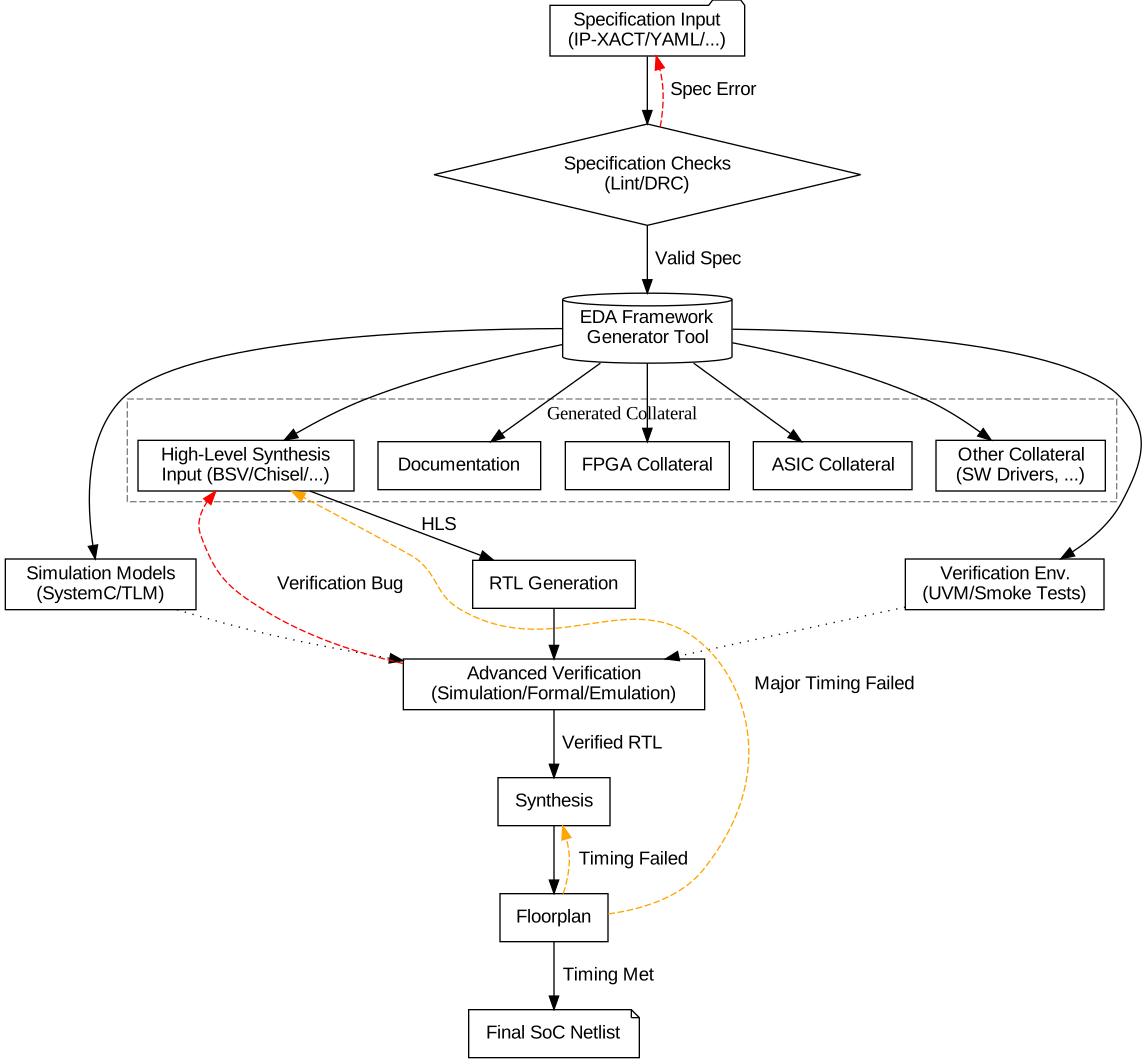
Good silicon begins with an unambiguous spec: a single document that every team, from RTL to firmware, can trust. When the spec is machine-readable, it stops being a PDF nobody opens and starts behaving like source code: you can lint it, gate it in CI, generate artifacts from it, and even prove that two versions are behaviorally identical. The spec becomes the product until silicon shows up.
Open-source helpers that make this practical:
| Purpose | Tools |
|---|---|
| Lint / DRC | reggen, SystemRDL-Compiler,
cerberus |
| Virtual models | SystemC + TLM-2.0, PySystemC,
QEMU-Device-Models |
| Formal interface checks | SymbiYosys, Yosys-SAT |
Benefits in practice: the generate-once-reuse-everywhere loop shaves days whenever a register file moves. Firmware boots months earlier on a virtual model that shares the exact address map with RTL, eliminating the dreaded bring-up weekend.
Design Entry: High-Level HDLs
High-Level HDLs matter because DSAs evolve quickly. Verilog forces you to hand-carve every state bit; C-based HLS hides the timing you often need to reason about. HLHDLs occupy a Goldilocks zone: parameterizable generators, explicit cycles, and modern type systems that catch mistakes before simulation.
| HDL | Host Lang | Notable Projects | USP |
|---|---|---|---|
| Bluespec | Haskell | piccolo |
Rule-based, strong types |
| Chisel3 | Scala | rocket-chip, boom |
FIRRTL back-end, rich generators |
| SpinalHDL | Scala | VexRiscv |
Efficient Verilog, simple syntax |
| Clash | Haskell | DSP blocks | Pure functional |
// Bluespec FIFO, atomic rule style
interface IFIFO;
  method Action enq(Bit#(8) d);
  method ActionValue#(Bit#(8)) deq;
  method Bool isEmpty();
  method Bool isFull();
endinterface

module mkFIFO(IFIFO);
  Reg#(Bit#(8)) data <- mkRegU;
  Reg#(Bool) valid <- mkReg(False);

  method Action enq(Bit#(8) d) if (!valid);
    data <= d;
    valid <= True;
  endmethod

  method ActionValue#(Bit#(8)) deq() if (valid);
    valid <= False;
    return data;
  endmethod

  method Bool isEmpty();  return !valid;  endmethod
  method Bool isFull();   return valid;   endmethod
endmodule
Key takeaways: correct-by-construction scheduling, and parameterization that cranks out dozens of variants for design space exploration.
Continuous Integration / Continuous Verification
Left-shifted verification glues together open simulators, formal engines, and cloud CI.
# .github/workflows/asic_ci.yml (excerpt)
name: ASIC-CI
on: [push, pull_request]
jobs:
  sim:
    runs-on: ubuntu-latest
    steps:
      - uses: actions/checkout@v4
      - name: Lint SV
        run: verible-verilog-lint $(git ls-files '*.sv')
      - name: Run Verilator smoke
        run: make test
      - name: Formal top-level
        run: symbiyosys formal/prop.sby
Every merge request proves that RTL, auto-generated drivers, and docs remain in sync, and the cloud farm gives you a health badge you can show management.
Algorithmic Design-Space Exploration
Designing a DSA today feels less like solving a jigsaw and more like navigating an NP-hard maze: hundreds of parameters influencing power, performance, and area in non-obvious ways. Exhaustive search is mathematically hopeless; intuition alone leaves performance on the table.
The design space is fundamentally a search problem, and the algorithmic toolkit is vast. You could start simple with greedy heuristics or hill-climbing for quick wins. Classical optimization methods like simulated annealing, genetic algorithms, or particle swarm work well when you have decent cost models. More recently, reinforcement learning agents and neural architecture search have shown promise in learning design patterns from exploration history.
| Approach | Example Tools | Use Case |
|---|---|---|
| Classical optimization | nevergrad, OpenDSE,
pyswarms |
Well-defined cost functions |
| Greedy/heuristic | Custom scripts, DEAP |
Fast iteration, simple spaces |
| ML-based | RL agents, AutoML frameworks | Learning from past designs |
The real enabler is fast yet faithful evaluation. Analytical proxies rank most candidates; only the top few go through RTL synthesis or cycle-accurate simulation. This closes the loop without melting your compute budget and lets you iterate architectures at DevOps velocity, not tape-out cadence.
Conclusion
The shift from traditional RTL-first design to algorithm-driven approaches marks a fundamental transformation in SoC development. For teams building domain-specific architectures today, success hinges on machine-readable specifications and formal constraint definitions. The convergence of formal methods and multi-objective optimization will enable systematic exploration of NP-hard design spaces with provable efficiency guarantees, delivering architectures that approach the theoretical limits of silicon’s capabilities.